Introduction
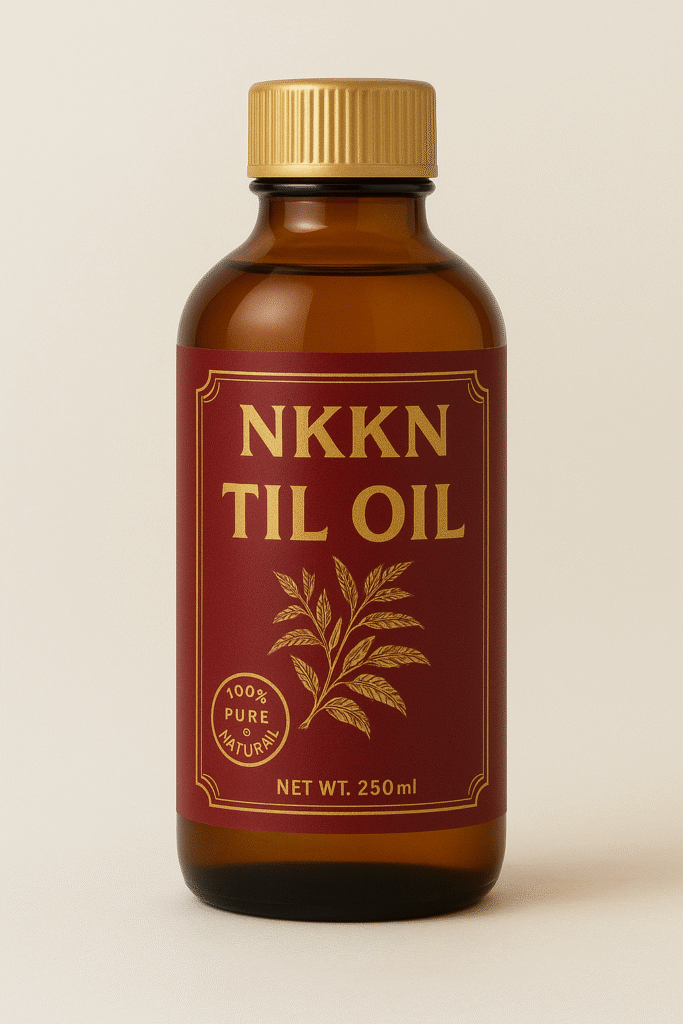
Til oil — more commonly called sesame oil or gingelly oil in many parts of India — has been a staple in Indian kitchens and Ayurvedic traditions for centuries. The tiny sesame seed (“til”) may be small, but it carries a dense load of nutrients, flavours and cultural significance. When pressed into oil, it becomes an ingredient not just for cooking, but for skin and hair care, therapy and health applications.
When you see a product labelled as “Til Oil” (or in Tamil “நல்லெண்ணெய்” / “குங்குமம்” etc.), especially from regional brands, you are typically looking at sesame seed (Sesamum indicum) oil that has been extracted by cold-pressing, or traditional methods. A brand we might refer to here tentatively as “NKKN Til Oil” would fall into this category if it exists. For clarity henceforth we’ll refer generically to til oil and note how a brand may differentiate itself.
What exactly is Til / Sesame Oil?
Sesame oil (gingelly oil) is derived from the seeds of the sesame plant. The process involves drying the seeds, cleaning them, sometimes roasting (for dark / strong flavour types) or leaving them un-roasted (for light types), and then pressing them to extract the oil. There are broadly two categories:
Cold-pressed / unrefined / ‘chekku’/wood-press extraction: This retains more of the aroma, flavour and nutritive compounds (e.g., sesamin, sesamol, antioxidants).
Refined / solvent-extracted / high-heat pressed: These often lose more flavour and some nutrients but have a more neutral taste and higher smoke point for deep frying.
In Indian parlance, the terms gingelly oil, til oil, nallennai (especially in Tamil Nadu) all refer to variations of sesame seed oil.
Production & Quality: What to look at
When you choose high-quality til oil, certain parameters matter — and regional brands typically emphasise these to differentiate themselves.
- Seed sourcing & cleaning: Good seed quality (clean, sun-dried, low moisture) yields better oil. Some brands emphasise sourcing from specific farming belts.
- Pressing method: Cold-press or traditional wooden “kolhu”/chekku method retains more nutrients. For example, one cold-pressed brand describes the process: “sun-dried seeds, wood-chekku, no chemicals.”
- Filtration & settling: Unfiltered oils may carry more sediment but higher natural content; filtered and refined oils will have clearer appearance.
- Certifications / value checks: Look for AGMARK, FSSAI labeling, free‐from adulteration. Some brand websites list FFA (free fatty acid) and IV (iodine value) checks.
- Packaging & storage: Sesame oil can oxidise; premium brands often pack in dark glass/plastic bottles, recommend storage away from heat/light, and mention best‐before date.
A typical example: One brand’s website states step-by-step process: seeds procured, sorted, machine-dried, double-filtration, AGMARK testing, packaging.
Health & Nutritional Benefits
Til oil offers several health advantages which make it more than just a flavourful cooking medium:
Healthy fats: It contains a good ratio of mono- and poly‐unsaturated fatty acids.
Antioxidants: Compounds like sesamol and sesamin act as natural antioxidants. For instance, a wood-cold pressed product notes: “Rich in Antioxidants: Contains sesamol and sesamin, which help reduce cell damage.”
Heart health: The combination of fatty acids and antioxidants supports cardiovascular health. The same product mentions “Omega-6 fatty acids … support cardiovascular health.”
Anti‐inflammatory properties: Traditional medicine uses sesame oil for its soothing qualities.
Skin & hair care: Because of its nutrient profile and antioxidant content, til oil is used externally for massage, hair nourishment and skin health.
Cultural/Ayurvedic uses: Sesame oil has a long tradition in Ayurveda—used in abhyanga (oil massage), as part of therapies, etc.
Culinary & Non-Culinary Uses
Culinary uses
Because of its nutty aromatic flavour, cold-pressed til oil is excellent for finishing dishes, drizzling over cooked food, salad dressings, stir-frying (in moderate heat) or for low-to-medium heat cooking.
Lighter refined versions may be used for general cooking/frying.
In South India, til oil is often used in tempering (tadka), pickles, parathas, chutneys for flavour.
Some traditional variants (wood-pressed) may have stronger aroma and are used specifically for flavouring rather than high-heat deep‐frying.
Non-culinary uses
Oil massage: Because of its warming and nourishing properties, til oil is used for baby massage, general body massage, joint massage.
Hair care: Used as hair oil for strengthening, nourishing, preventing premature greying (due to antioxidant content).
Skin care: Some people apply sesame oil as a base oil for moisturising, or for specific skin treatments.
Quality Differentiation: How a brand might present “NKKN Til Oil”
If we assume a brand “NKKN Til Oil”, here’s how it might present itself in the market — many regional brands already follow such arguments:
“100% Pure / Cold-Pressed / Unrefined” — emphasising minimal processing to retain the natural benefits.
“Traditional extraction / Wood-pressed / Kolhu / Chekku” — appealing to tradition and authenticity.
“Sourced from selected farms / Sun-dried seeds” — emphasising seed quality.
“Free from additives / No colour / No preservatives” — appealing to health-conscious buyers.
“Full of natural aroma & flavour / Rich nutty taste” — for the gourmet element.
“Multiple pack sizes: 500 ml, 1 L, 5 L tin” — catering to both household and bulk buyers.
“Health benefits: heart friendly, skin & hair care” — enabling value beyond cooking.
“AGMARK / FSSAI certified / Tested for FFA, IV” — emphasising trust and safety.
As an example of such brand-style presentation: Another brand states on its website:
“Cold-pressed … retains the natural golden colour and fragrance … improves heart health, rich in antioxidants, contains Omega-6, boosts skin health, adds to good cholesterol levels.”
Storage, Usage Tips & Cautions
Storage: Keep the bottle in a cool, dark place away from direct sunlight and heat. Some brands recommend using within 3-6 months for cold-pressed oils for best aroma and nutrition.
Usage: Because of the distinct flavour, use sparingly when mixing with other oils; use for final seasoning to enjoy aroma. For high‐heat frying, a more refined seed oil may be better as cold-pressed ones have lower smoke point.
Adulteration vigilance: Unfortunately, edible oils can be adulterated; hence buyers should choose trustworthy brands and check for signs of purity (clear aroma, no off smell, proper packaging).
Sedimentation: In unrefined cold-pressed oils, some sediment or tiny particles may settle down; this is normal, not a defect, as one brand notes when unfiltered: “Some small solid particles … may slowly settle down at the bottom … they are natural and safe to consume.”
Reuse caution: Re-using cooking oil repeatedly (especially at high heat) degrades nutrients and may generate harmful compounds.
Market & Regional Significance (India)
In India, the consumption of til/gingelly oil is particularly significant in South Indian states (Tamil Nadu, Kerala, Andhra Pradesh) where traditional cuisines and Ayurvedic practices emphasise its use.
Many regional mills and cold‐press units produce til oil under local/household brands. For example, a product listing shows “100% Pure Gingelly Oil – A-grade Cold Pressed Liquid” by a Tamil Nadu based manufacturer.
Brands differentiate by region, seed source (black sesame seed, white, red), and extraction method (wood-chekku vs mechanical).
Challenges and Consumer Awareness
Awareness gap: Many consumers may assume all “sesame oil” is the same; but flavour, nutrition and cooking suitability vary widely depending on processing.
Price vs. value trade‐off: Cold-pressed, premium oils tend to cost more; consumer need to evaluate whether flavour and health benefits justify the price.
Adulteration/Quality variance: As with many edible oils, there is risk of adulteration or mislabelling. This makes choosing known/trusted brands important.
Cooking suitability: As mentioned, high-heat frying may not be ideal for some cold-pressed oils; consumers need to match usage to oil type.
If You’re Evaluating “NKKN Til Oil”
While I couldn’t locate specific verifiable information under the exact brand “NKKN Til Oil”, if you were considering this product, here are questions you might ask:
What is the exact extraction method (cold-pressed, wood-chekku, mechanical)?
What type of sesame seeds are used (white, black, red)? Are they roasted or un-roasted?
What certifications or quality tests are provided (AGMARK, FSSAI, FFA/IV values)?
What is the packaging and storage advice?
What is the smoke point of the oil, and for what types of cooking is it recommended?
Are there visible sediments or is it filtered? (If unfiltered, is that expected?)
What is the shelf‐life and storage instructions?
How is the brand supported (customer service, transparency about sourcing)?
Conclusion
Til oil is much more than a cooking oil—it holds culinary, nutritional and cultural value. When you pick a high‐quality til oil, ideally from a brand that emphasises purity, traditional extraction, seed quality and health benefits, you are investing in flavour, health and heritage.
If “NKKN Til Oil” exists in your region, and the brand provides transparency around the above points, it could very well be a strong choice. If you like, I can attempt a deeper dive (via tireless local/regional databases) to find detailed brand-specific information about NKKN—even contact address, seed source, extraction method and consumer reviews. Would that be helpful to you?